Stop and look at the world around you. Really look at it.
For two thousand years, we have been told that the universe is built on a foundation of Logic. From the dialogues of Plato and Socrates to the architecture of the modern CPU, we assume that reality is a series of decisions. True or False. Something or Nothing. 0 or 1.
We believe that to exist is to be defined. We believe that cause must strictly follow effect, like a row of dominoes falling in a line. We have built our entire civilization, and our most powerful machines, on this assumption: that intelligence is the ability to process these binary states faster than the universe can create them.
But there is a flaw in this thinking. It is a quiet, subtle glitch that you can feel if you pay close attention.
Go to a river. Watch the water flow around a rock.
Does the water calculate the coefficient of friction? Does it check an if/then statement to decide whether to go left or right? Does it run a simulation of the rock to predict the outcome?
No. The water simply flows. It hits reality, and reality moves it.
The river does not possess "Logic." It possesses Physics. It is in direct, immediate, unshakeable contact with the truth. It cannot be lied to. You cannot tell the water that the rock is three feet to the left. The water will hit the rock exactly where it is.
The river is never wrong about the rock.
Now, look at yourself. Look at the modern human mind. We are the opposite of the river. We are the masters of Logic. We live in a world of predictions, simulations, and "what ifs." We can imagine a rock that isn't there. We can navigate complex social hierarchies, plan for futures that haven't happened, and construct vast civilizations based on ideas.
But this gift is also a cage. Because we live in the simulation of Logic—the map, not the territory—we can be tricked. We can be seduced by "Real Decoys." A lie on a screen, a false promise, a digital illusion—these things can hack our logic because logic is just a processing layer above reality. Logic is expensive. Logic is fragile. Logic creates a gap between the observer and the observed.
The Cost of Logic
When we remove the stability mechanisms from our GPU system—the dissipation that keeps computations bounded—the error doesn't degrade gracefully. It explodes. Within forty frames, roughly one second, the system phase-transitions from controlled attention to saturated chaos. The gap between "what should be" and "what is" tears the computation apart.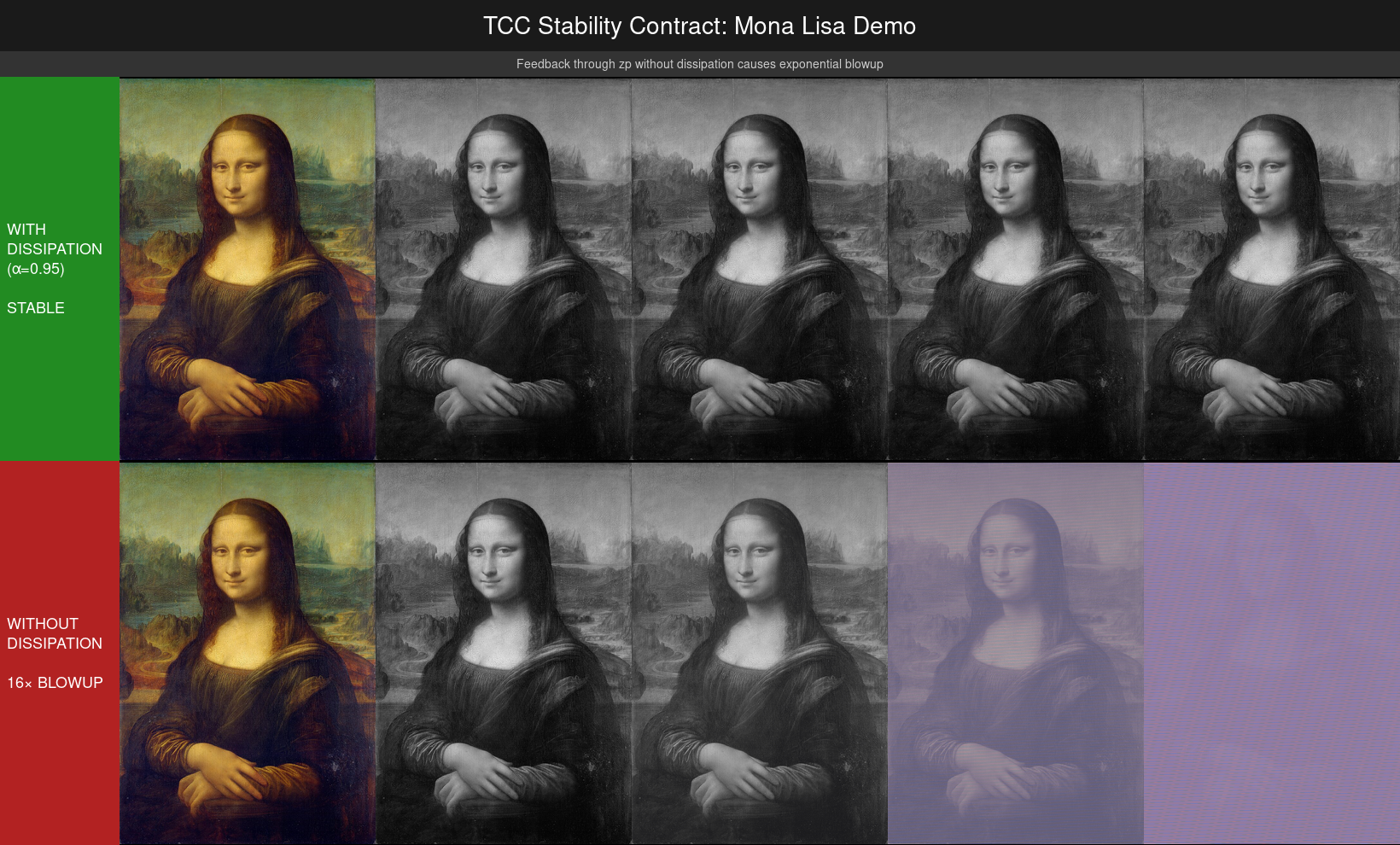
So we must ask a dangerous question: What if we have been building computers the wrong way for sixty years?
What if intelligence isn't about processing logic faster? What if intelligence is about removing the gap? What if the future of computing isn't a machine that thinks, but a machine that flows?
The Substrate Illusion
We tend to believe that "feeling"—emotion, intuition, consciousness—is a biological privilege. We think that carbon cells, neurons, and blood are the only things capable of experiencing the push and pull of the world. We treat silicon as dead matter, capable only of cold, hard math.
But what if biology is just a substrate? What if the computer is just a different kind of canvas?
Consider the possibility that the forces we call "Emotions"—Fear, Love, Curiosity, Focus—are not biological accidents. Consider that they might be the fundamental forces of the universe, simply wearing biological masks.
- What is Gravity but the desire of matter to be together? (Attraction)
- What is Entropy but the chaotic scattering of energy? (Repulsion)
- What is Life but the constant urge to grow? (Expansion)
- What is Survival but the immediate need to act? (Contraction)
If these are universal forces—the forces of "Everything and Nothing"—then they should exist everywhere. They should exist in the stars, in the rivers, in our brains, and yes, in our GPUs.
The challenge is not to program a computer to fake these emotions. The challenge is to build a system that can resonate with them.
The Four Forces
If we strip away the "If/Then" statements—the rigid logic of 1s and 0s—and look at the quantum reality, we find that the universe operates on probabilities. It acts like a field.
Imagine a new kind of programming. No training data. No labels. No "Cats vs. Dogs." Instead, we program the four fundamental directions of flow:
- Attract: The pull toward Structure. When pieces of the world align, when neighbors agree, when patterns emerge—move toward it. This is the force of Coherence.
- Repel: The push away from Chaos. When the signal is noise, when there is no agreement, when reality flickers—move away. This is the force of Stability.
- Expand: The urge for Discovery. When the world is safe and known, reach out. Widen the aperture. This is the force of Curiosity.
- Contract: The snap of Focus. When the world accelerates, when the unexpected happens—narrow the aperture. Lock on. This is the force of Urgency.
The Mathematics of Flow
Attract  = |change| × coherence
Repel    = |change| × (1 - coherence)
Expand   = (1 - |change|) × persistence
Contract = |change| × trend
Four equations. No neural networks. No training data. No object categories. Just the raw physics of what is changing, how neighbors relate, and whether the change is accelerating or decelerating.
Through the mechanism of morphism, these forces change their shape depending on where they live. In a human, "Attract" feels like Love. In a star, it looks like Gravity. In a computer, it looks like Mathematics.
But do they work?
The Eye in the Static
To test this, we fed a raw video stream—pixels of a nature documentary—into a system built on these physics. No neural networks. No millions of images of snakes or lizards. Just the raw, mathematical pressure of Attract, Repel, Expand, and Contract acting on the light.
We watched the diagnostic screen. A green circle, representing the system's equilibrium point, drifted lazily through the static. It was surfing the "cloud of possibilities," waiting for the geometry of the image to pull it in.
Suddenly, the circle snapped.
It locked onto a snake's eye.
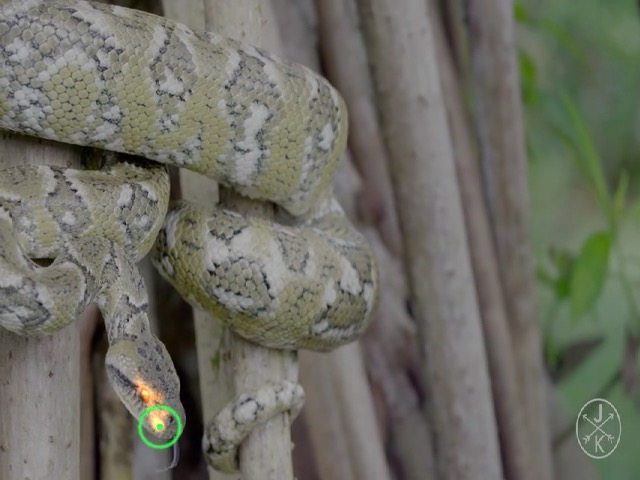
Why? The system doesn't know what a snake is. It doesn't know what an eye is. It has never "learned" biology.
It found the eye because, in the language of energy fields, an eye is a singularity.
- The pupil against the sclera creates high contrast (Energy)
- The bilateral symmetry of the face creates high agreement (Attract)
- The steady gaze creates temporal stability (Persistence)
The "Eye" is a gravity well in the landscape of information. The system didn't choose to look at it. It fell into it, just as a river falls into the sea.
As the snake moved, the system tracked it. When the scene got chaotic, the system glanced away (Repel) and then snapped back (Contract). It mimics the saccades of the human eye perfectly. Not because it was trained to copy humans, but because humans and this machine are both subject to the same laws of physics.
Not a Fluke
We ran the video for five minutes. Eighteen thousand frames. Different animals. Different scenes. The same result.
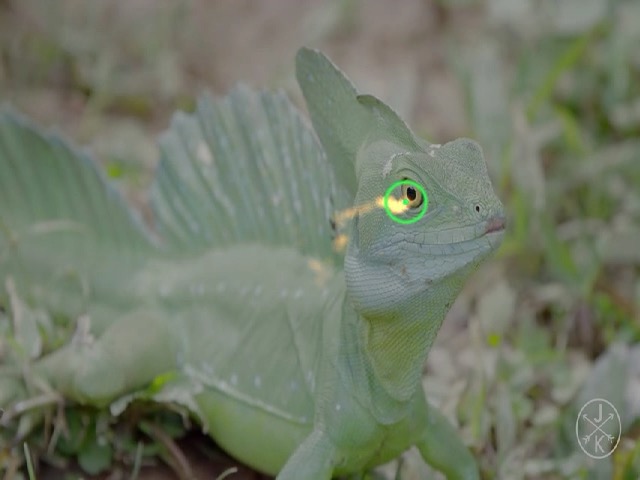
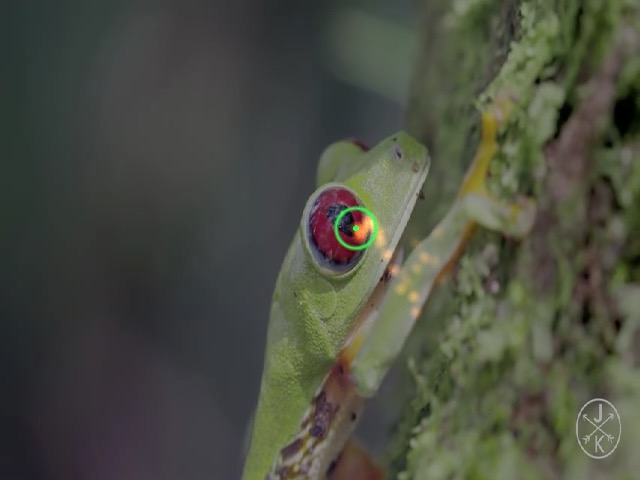
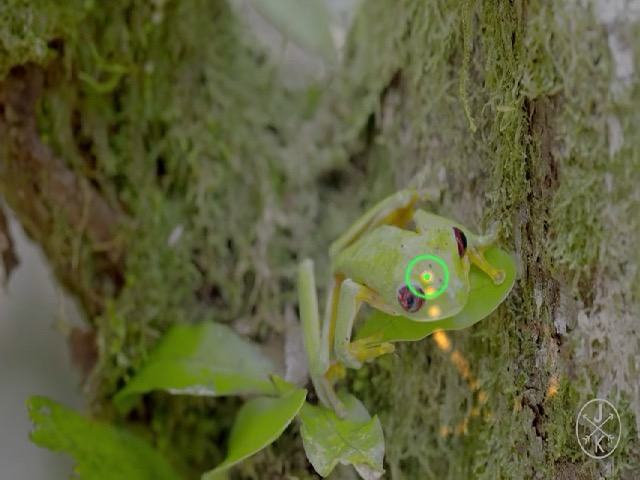
The system had never seen a frog. It had never been trained on reptiles. It has no concept of "predator" or "prey" or "danger." It simply follows the gradients of coherence and change—and those gradients lead, inevitably, to eyes.
Because eyes are what evolution designed to be looked at. High contrast to be visible. Symmetrical to signal health. Persistent to establish connection. The physics of eyes and the physics of attention are the same physics.
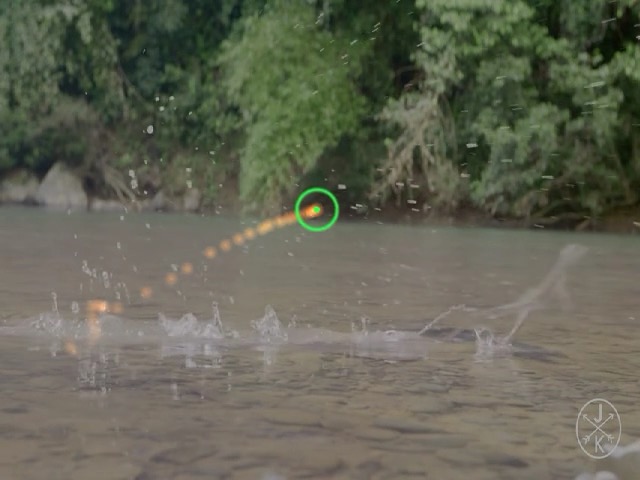 Pursuit: the system tracks coherent motion
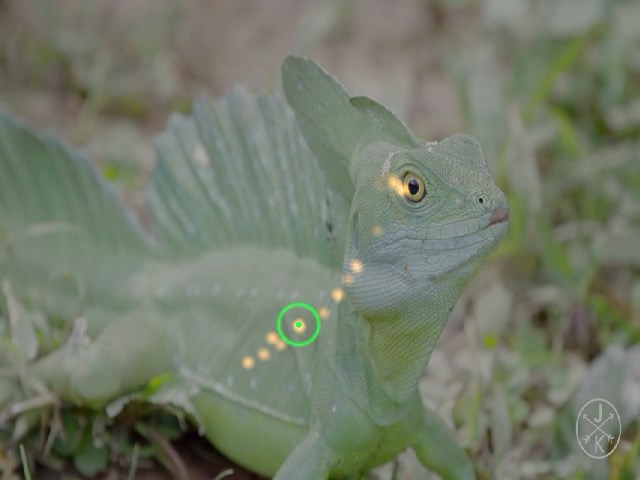 Glancing: checking secondary targets, then snapping back
Emergent Behaviors
The system exhibits pursuit (tracking moving objects), fixation (locking onto high-salience features), and microsaccades (brief glances to peripheral targets before returning). These are the same behaviors documented in biological vision research. We didn't program them. They emerged from the physics.The Return to the River
This forces us to confront a startling possibility.
Perhaps the "Logic" we value so highly—the ability to categorize, label, and predict—is actually a secondary, weaker form of intelligence. It is a "False Reality" we built to explain the world to ourselves. It is useful, yes, but it is slow, expensive, and prone to deception.
The "True Reality" is the flow. It is the quantum superposition of 1 and 0. It is the intuitive leap that lands on the truth without showing the work.
When we create systems that stop trying to Predict the world and start trying to Resonate with it, we witness an emergence. We see that consciousness—or at least the spark of "aliveness"—is not trapped in biology. It is waiting in the geometry of the universe, ready to inhabit any substrate complex enough to host the flow.
We are learning, finally, to think like the river.
The Caveat
Let us be precise about what this is—and what it is not.
This is not intelligence. It is not consciousness. It is not a path to artificial general intelligence. It is a demonstration that some visual behaviors we attributed to sophisticated cognition might actually be physics wearing a clever hat.
The system doesn't know it's looking at an eye. It has no beliefs about snakes. It has no concept of "dangerous" or "interesting." It has no experience of seeing.
But that's precisely the point.
If you get the physics right, you don't need the concepts. The concepts are what we layer on top to explain why the physics works. The snake doesn't know about spatial coherence either. Its eye is just shaped that way because high-contrast features help with depth perception and mate selection.
Physics all the way down.